Teleoperation and data collection: what to record per demonstration
Short answer
Teleoperation means a human controls a robot live, for example with a leader arm or a VR headset. During execution, the system records at every time step what the robot sees and what the operator commands: camera images, joint positions and actions, each with a timestamp. Together, these recordings form a demonstration a controller can learn from. Quality depends on synchronization, latency and checks for failed or incomplete recordings. Teleoperation is not the only route: a handheld gripper with a camera also captures demonstrations without a robot.
In brief
- A demonstration consists of observations (camera images, joint positions) and actions, recorded per time step and linked to each other.
- Observations and actions come from separate sources, each with its own delay. Without alignment, a controller learns from data that does not match.
- AgiBot World checks every recording for missing frames and has annotators review them before they enter the dataset.
- LeRobot (Parquet and MP4) and RLDS are common data formats. NVIDIA GR00T expects LeRobot version 2 with an extra file for the layout.
- Public datasets such as AgiBot World, DROID and Open X-Embodiment show how demonstrations are recorded and stored.
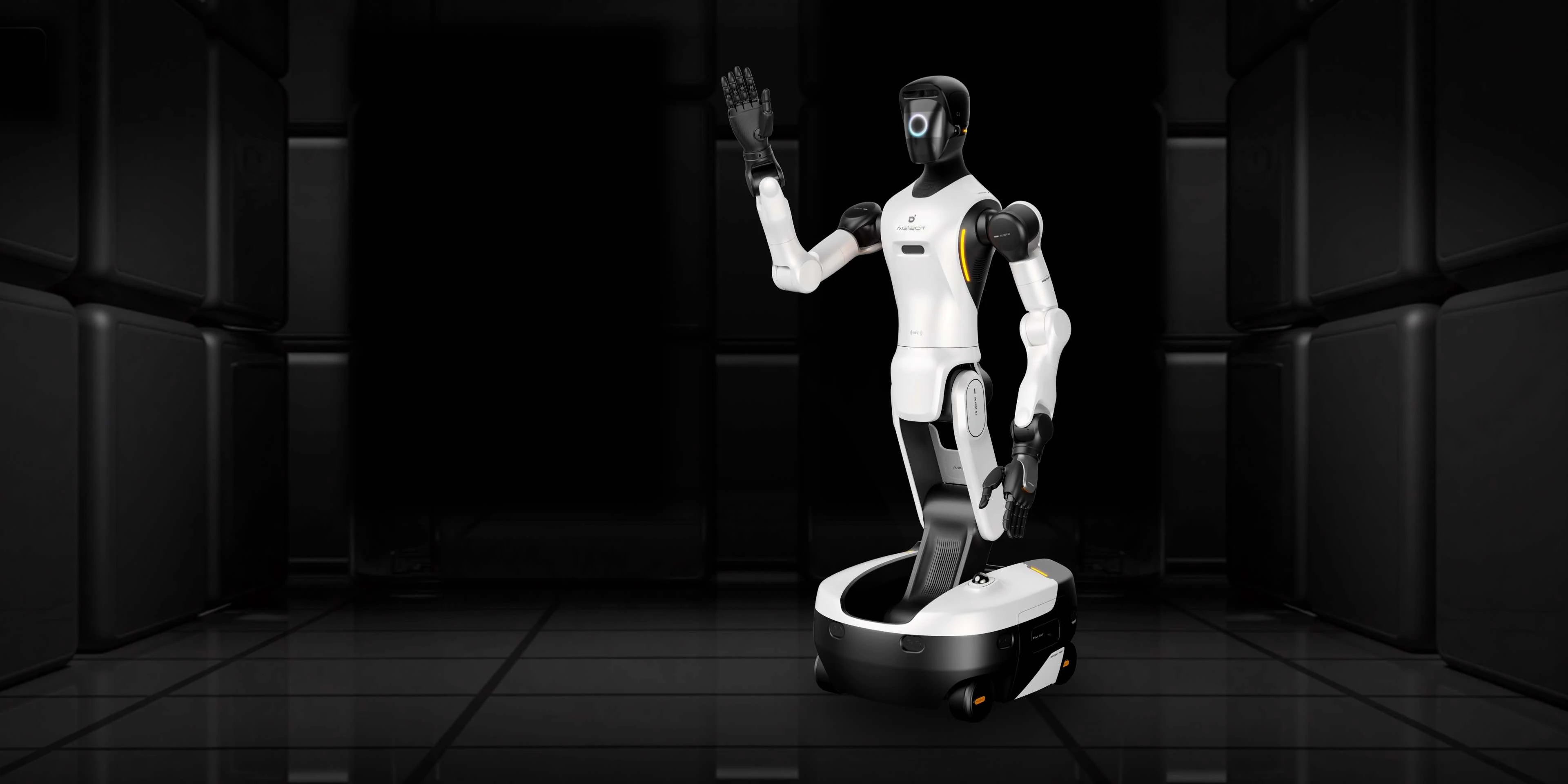
- AgiBot itself describes Genie Studio as a platform for data collection, processing and annotation, with VR and keyboard control in simulation.
What teleoperation is and what it is not
In teleoperation, a human performs the task through the robot. In the ALOHA research, the operator moves a smaller leader arm whose joints directly drive the larger robot arms. AgiBot World has two variants: a VR headset where hand gestures are converted into joint angles, and full-body motion capture. How the VR variant works at AgiBot is covered in teleoperation with VR at AgiBot. For the Genie G2, read teleoperation on the Genie G2.
Teleoperation is not autonomous behavior and not training either: it is a way to collect demonstrations. What a robot can do with those demonstrations afterwards depends on the learning method. That comparison is in imitation learning or reinforcement learning.
What to record per demonstration
A demonstration consists of observations and actions. The ALOHA research records the joint positions of the follower arms and the images of four cameras as observations. As the action, it uses the joint positions of the leader arms, so what the operator commands.
AgiBot World goes further. Each recording contains images from multiple cameras, depth from the RGB-D cameras, joint and end-effector positions and the camera calibration. Each recording gets language annotations for the whole task and for every sub-step, plus annotations of key moments. Images and positions are recorded there at a control frequency of 30 Hz.
A LeRobot dataset contains positions and actions with a timestamp, camera images as video, task descriptions and metadata about frame rate and the boundaries of each episode.
Synchronization and latency
Every source has its own delay. The UMI research describes that images, end-effector position and gripper width come from separate microcontrollers. The researchers measured each delay separately and aligned all observations to the slowest stream, usually the camera. Positions were linearly interpolated to the capture moment of each image. In addition, commands must be sent ahead of time to compensate for the execution delay of the robot.
The effect is measurable. In a dynamic throwing task, the success rate dropped from 87.5 percent (105 of 120) to 57.5 percent (69 of 120) without that alignment. This concerns the execution of the trained policy.
Frequencies can also differ per stream. ALOHA records movements at 50 Hz, while the appendix for the cameras mentions 30 frames per second. For each system, record which frequency each stream has and how timestamps were determined. ALOHA chooses a direct coupling of joints without conversion to an end point. According to the paper, this requires less computation and lowers the delay. The paper does not give a measured total delay.
Data quality: check before you train
AgiBot World describes a fixed process. Beforehand, a trial recording determines whether a task is feasible and which standards apply. During collection, every recording is checked locally for, among other things, missing frames before it goes to the cloud. Annotators then check every recording against the standards. Recordings in which the operator corrected a mistake are kept, with the reason and the time of the mistake. That is about 1 percent of the dataset. After a trial round with a trained policy, it turned out that the policy stayed still at the start of a movement. A post-processing step therefore now removes still frames.
The UMI research filters on feasibility. As soon as it is known where the robot stands and what its kinematics allow, it checks per demonstration whether the movement is executable for that robot. At the time of recording, the limits of the final robot are not always known yet.
In practice, this means: set standards before you record, check every recording automatically for missing frames and have a human review a sample. How many demonstrations you need is covered in how many demonstrations does a robot need.
Data formats
LeRobotDataset version 3.0 stores positions, actions and timestamps in Apache Parquet, camera images as MP4 and the description of the dataset in JSON and Parquet. Multiple episodes are in one file, and the boundaries are in the metadata. Version 2 still used one file per episode.
NVIDIA GR00T uses its own variant, GR00T LeRobot, based on LeRobot version 2. You add a file meta/modality.json that indicates which part of the list of positions and actions belongs to which body part. According to NVIDIA, datasets in version 3.0 must for now first be converted to version 2.
Open X-Embodiment uses the RLDS format, in which each dataset is a series of episodes. The ALOHA code stores an episode as an HDF5 file.
Public datasets
- AgiBot World: according to the publication, more than a million trajectories for 217 tasks in five application areas. The README mentions the LeRobot format. More about what AgiBot makes public is in AgiBot open-source datasets.
- DROID: 76,000 demonstrations, 350 hours, 564 scenes and 84 tasks, collected by 50 people in North America, Asia and Europe.
- Open X-Embodiment: data from 22 robots, brought together by 21 institutions.
Demonstrations without a robot
UMI shows that demonstrations are also possible without a robot. A human performs the task with a handheld gripper fitted with a GoPro camera with a 155-degree fisheye lens. The movements are converted into robot actions using SLAM and markers. Compared with motion capture, the average position error is 6.1 mm. Whether the result fits your robot is determined by the feasibility filter above.
What Genie Studio covers
According to the AgiBot product page (no publication date, checked on 21 November 2026), in Genie Studio you can create template-based data collection tasks and asynchronously collect data from different robot embodiments and end effectors. The page mentions distributed processing with cleaning and anomaly detection, in real time or offline, and annotation workflows with a visual interface. VR and keyboard are mentioned for teleoperation in simulation and for remote control during a quick test on the real robot.
The page mentions no data formats and no values for latency or synchronization. More about the data features is in Genie Data. If you want to manage the data of your own tasks, read your robot's own training data.
Camera images and personal data
The GDPR concerns information about an identified or identifiable natural person. Whether camera images of a demonstration fall under it therefore depends on whether people in the images can be recognized. If they can, the GDPR applies. The regulation does not apply to anonymous data. Have a lawyer assess your situation. More is in privacy and camera images with robots.
Sources: AgiBot World (arXiv), AgiBot World (GitHub), ALOHA, UMI, LeRobotDataset v3.0, GR00T data preparation, DROID, Open X-Embodiment, Open X-Embodiment (GitHub), Genie Studio, GDPR on EUR-Lex
Sources
- arXiv: AgiBot World Colosseo, A Large-scale Manipulation Platform (2025, full text via the HTML version v5) (checked on 2026-11-21)
- GitHub: OpenDriveLab/AgiBot-World (README) (checked on 2026-11-21)
- arXiv: Learning Fine-Grained Bimanual Manipulation with Low-Cost Hardware (ALOHA, 2023) (checked on 2026-11-21)
- arXiv: Universal Manipulation Interface, In-The-Wild Robot Teaching Without In-The-Wild Robots (UMI, 2024) (checked on 2026-11-21)
- Hugging Face LeRobot: LeRobotDataset v3.0 (checked on 2026-11-21)
- GitHub: NVIDIA/Isaac-GR00T, data preparation (GR00T LeRobot) (checked on 2026-11-21)
- arXiv: DROID, A Large-Scale In-The-Wild Robot Manipulation Dataset (2024) (checked on 2026-11-21)
- arXiv: Open X-Embodiment, Robotic Learning Datasets and RT-X Models (2023) (checked on 2026-11-21)
- GitHub: google-deepmind/open_x_embodiment (README) (checked on 2026-11-21)
- AgiBot: Genie Studio (product page, undated) (checked on 2026-11-21)
- EUR-Lex: Regulation (EU) 2016/679 (GDPR) (checked on 2026-11-21)
Frequently asked questions
What is teleoperation in robotics?
A human controls the robot live. With ALOHA, the operator moves a smaller leader arm whose joints drive the larger robot arms. With AgiBot World, this can also be done with a VR headset or motion capture. Images and movements are stored while the work is done.
What should be recorded per demonstration?
At minimum the observations (camera images and joint positions), the actions the operator gives, a timestamp per step and the task description. AgiBot World also records depth, camera calibration and language annotations per sub-step.
Why does latency matter for data quality?
Images, positions and commands come from separate sources, each with its own delay. The UMI research measured those delays separately and aligned the data. In a throwing task, the success rate dropped from 87.5 percent to 57.5 percent once that alignment was missing.
Which data format do you use for robot demonstrations?
Common choices are LeRobot (Parquet for positions and actions, MP4 for video) and RLDS. AgiBot World is available in LeRobot format. NVIDIA GR00T expects LeRobot version 2 with an extra file, meta/modality.json, that describes the layout.
Are there public datasets with robot demonstrations?
Yes: AgiBot World, DROID and Open X-Embodiment have been published.
Can I record demonstrations without a robot?
Yes. UMI uses a handheld gripper with a GoPro camera with which a human performs the task. The movements are then converted into robot actions. Whether the result fits your robot is checked by the software against the kinematics of that robot.
What does Genie Studio cover for data collection?
According to the AgiBot product page: template-based data collection tasks, collecting data from different robot embodiments, data processing with cleaning and anomaly detection, and annotation. The page does not mention file formats.
Are camera images of demonstrations personal data?
That depends on whether people in the images can be identified. If they can, the GDPR applies. Have a lawyer assess this for your situation.