Where do your robot's camera images go?
Short answer
Camera images in which people are recognizable are personal data under the GDPR, even if the robot only uses them to navigate. The company that deploys the robot determines the purpose and means and is therefore responsible. Facial images only become biometric data, with a stricter regime, when they are technically processed to uniquely identify someone. Record up front what the robot captures, where it goes, how long it is kept and who gets to see it.
In brief
- Recognizable people on camera are personal data. This applies to collecting and using images, not only to storing them.
- The company that deploys the robot determines the purpose and means and is the controller. A supplier that processes on your behalf is a processor.
- Facial images are special category data when they are technically processed to uniquely identify someone. Merely detecting faces is something different.
- The European data protection authorities (EDPB) recommend deleting video images after a few days. Longer than 72 hours requires a stronger justification.
- A DPIA is mandatory where processing is likely to result in a high risk, including large-scale systematic monitoring of publicly accessible areas.
- A works council has a right of consent on rules for the personal data of employees and on facilities that can monitor behavior or performance.
When images are personal data
The GDPR (General Data Protection Regulation, Regulation (EU) 2016/679) calls any information about an identified or identifiable person personal data. A face on a camera image falls under it, as does a recognizable person walking through a room. Processing also means collecting, recording, using and storing, with or without automated means. A robot that only uses images to navigate therefore also processes personal data as soon as people are recognizable in the image.
The company that deploys the robot and determines what the images are used for and how is the controller. A supplier or cloud service that processes images on behalf of that company is a processor. The EDPB (the European Data Protection Board, in which the national supervisory authorities cooperate) has published guidelines for video devices. They were written for surveillance cameras, but the GDPR itself is not tied to a device. The principles in those guidelines are therefore also useful for a robot with cameras.
What a robot with cameras does
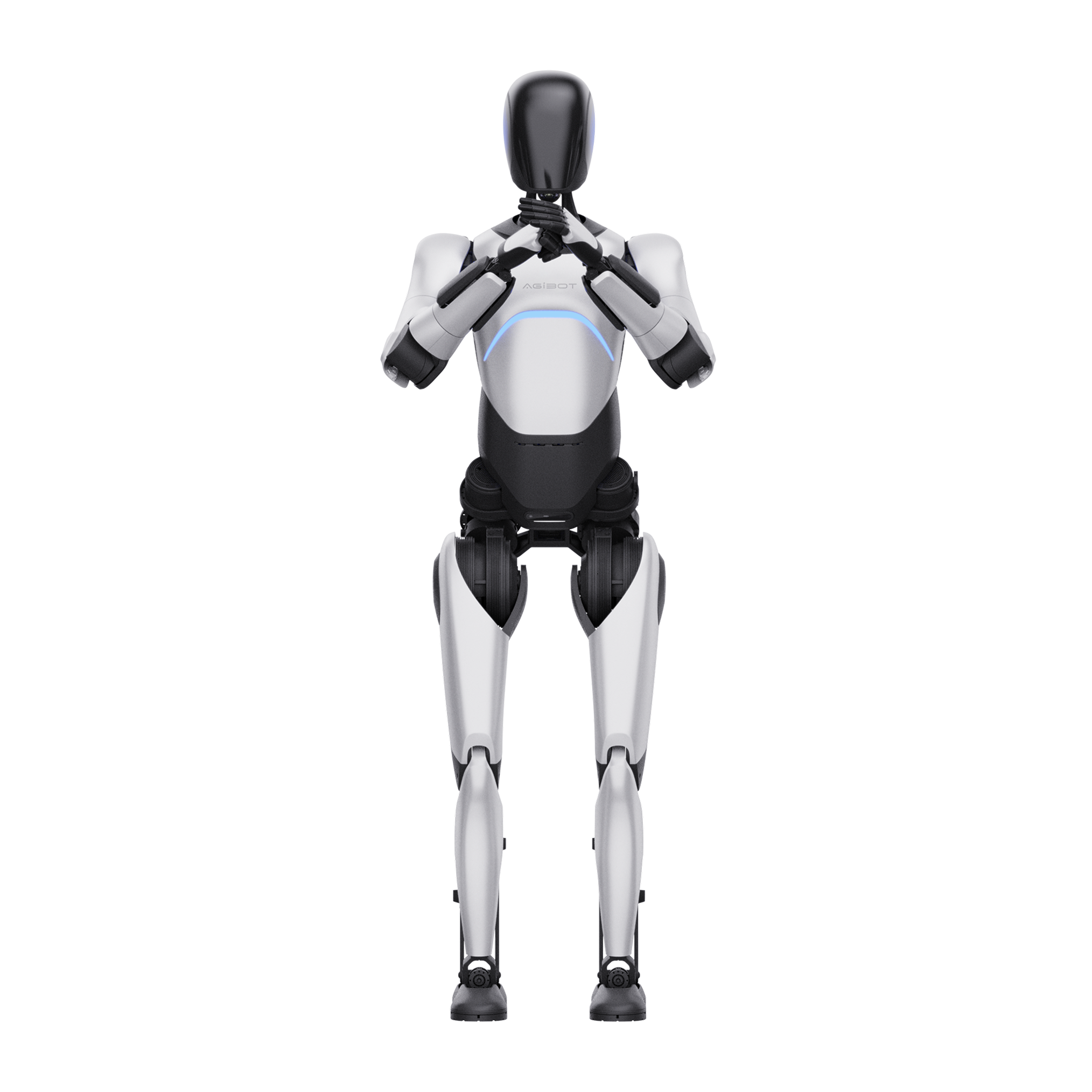
A humanoid uses cameras and a LiDAR to navigate, recognize objects and avoid people. What that involves in practice differs per model. AgiBot's developer documentation for the A2 and A2 Ultra (AimDK, version 2.1) mentions fisheye cameras on the chest, an RGB-D camera in the head and at the waist, and a LiDAR in the neck. The images become available as ROS2 topics, a standard interface for robot software. The documentation does not describe whether images are stored and does not mention facial recognition. The product page of the A2 Ultra mentions greeting visitors via facial recognition as an application and says nothing there about data processing. Whether the robot only notices faces or also recognizes them, and what happens to the images, you must therefore establish with the supplier and in the configuration.
Facial recognition and biometric data
The GDPR in principle prohibits processing biometric data to uniquely identify someone. Biometric data is data resulting from specific technical processing of physical, physiological or behavioral characteristics that allows or confirms the unique identification of a person, such as facial images. The EDPB explains that video images of a person are not in themselves biometric data if they have not been technically processed to identify someone. The stricter regime therefore applies when the system compares faces with stored data to know who someone is, and not when it merely notices that there is a face.
There are exceptions to the prohibition, such as the explicit consent of the data subject. The EDPB writes that a company that uses biometric recognition itself, for example for marketing, statistics or security, in most cases needs the explicit consent of all data subjects. The Netherlands also has a national exception for authentication and security under strict conditions. The EDPB asks controllers to first assess whether there is a less intrusive way to achieve the same purpose. For a robot that shows visitors the way, recognizing individuals is rarely necessary.
Under the AI Act, it is also prohibited to infer the emotions of employees in the workplace, except for medical or safety reasons, and users of emotion recognition must inform people. See The AI Act and robots for the dates.
Storing images and informing people
- Retention period. Personal data may not be kept longer than necessary for the purpose. For surveillance images, the EDPB assumes that in most cases they are deleted after a few days, preferably automatically. The longer the period, certainly above 72 hours, the stronger the justification must be.
- Information. People must be able to know that images are being made. The EDPB recommends a layered approach: a sign or notice with the key information, such as the purpose, the controller and the rights of data subjects, and in addition the full information in a findable place. A sign belongs at the entrance to the space, not only inside it.
- Privacy by design and by default. By default, the controller must process only the personal data that is necessary for the purpose. This applies to the amount, the retention period and access. A function you do not need, you switch off.
Five questions to answer up front
| Question | Why |
|---|---|
| What is captured: live image, recordings, facial features? | Determines whether and which personal data you process |
| Where is it processed: on the robot, on your server or in the cloud? | Determines who has access; see Edge or cloud: does the robot compute by itself? |
| How long is it kept? | Limit storage to what is necessary for the purpose |
| Who has access? | Restrict and record access; see also cybersecurity for robots |
| Who is informed and how? | Visitors and employees have a right to information |
Carrying out a DPIA
A DPIA is an assessment of the effect of processing on the protection of personal data. It must be done in advance for processing that is likely to result in a high risk, especially with new technology. A DPIA is mandatory, among other cases, for systematic and large-scale monitoring of a publicly accessible area and for large-scale processing of special category data. Each national supervisory authority publishes a list of processing operations for which a DPIA is mandatory. For a DPIA you ask the data protection officer (DPO) for advice, if you have one.
Employees and the works council
When a robot with cameras works in a company, employees come into view. The Works Councils Act gives the works council a right of consent on a rule concerning the processing and protection of personal data of the people working there, and on a rule concerning facilities aimed at or suited to observing or monitoring presence, behavior or performance. It is enough that a facility is suited to this. A robot with cameras can fall under that, even if that is not its purpose. More about consulting the works council can be found in The works council and robotization.
Sources: GDPR, EDPB Guidelines 3/2019, AI Act, Works Councils Act, GDPR Implementation Act, AgiBot A2 Ultra, AimDK A2 sensor data
Sources
- EUR-Lex: Regulation (EU) 2016/679, GDPR (checked on 2026-11-22)
- EDPB: Guidelines 3/2019 on processing of personal data through video devices (version 2.0, 29 January 2020) (checked on 2026-11-22)
- EUR-Lex: Regulation (EU) 2024/1689, AI Act (checked on 2026-11-22)
- wetten.overheid.nl: Works Councils Act (Wet op de ondernemingsraden) (checked on 2026-11-22)
- wetten.overheid.nl: GDPR Implementation Act (exception for biometric data) (checked on 2026-11-22)
- AgiBot: product page AGIBOT A2 Ultra (checked on 2026-11-22)
- AgiBot: AimDK A2 / A2 Ultra development guide v2.1, 7.4 Sensor Data (checked on 2026-11-22)
Frequently asked questions
Are images the robot only uses to navigate also personal data?
Yes, as soon as people are recognizable in them. The GDPR looks at the data, not at the purpose of the camera. Collecting, using and storing are all processing. What you can do is limit the amount, for example by not storing images if the robot only needs them in the moment.
Is a face on camera always biometric data?
No. According to the EDPB, video images of a person are not in themselves biometric data if they have not been technically processed to identify the person. The stricter regime for special category data applies to biometric data used to uniquely identify someone.
Do I always have to do a DPIA?
No. A DPIA (data protection impact assessment) is mandatory for processing that is likely to result in a high risk, for example large-scale systematic monitoring of a publicly accessible area or large-scale processing of special category data. Each national supervisory authority publishes a list of processing operations for which a DPIA is mandatory.
How long may I keep images?
As short as necessary for the purpose. For surveillance images, the EDPB assumes that in most cases they are deleted after a few days, preferably automatically. If you keep them longer than 72 hours, you must better justify why that is necessary.
Can I turn off facial recognition?
That depends on the model and the software. AgiBot's developer documentation for the A2 describes cameras and a LiDAR but does not mention facial recognition. Ask the supplier in writing which functions exist, which you can switch off and whether faces are only detected or also recognized.
Who is responsible if the supplier processes the images?
You remain the controller if you determine the purpose and means. A supplier that processes images on your behalf is a processor. Put that in writing in your agreements and ask where the data is processed and stored.
What if the robot also films employees?
Then the same rules apply, and in the Netherlands the works council has a right of consent on rules for processing employees' personal data and on facilities suited to monitoring presence, behavior or performance.