Humanoids in manufacturing
Short answer
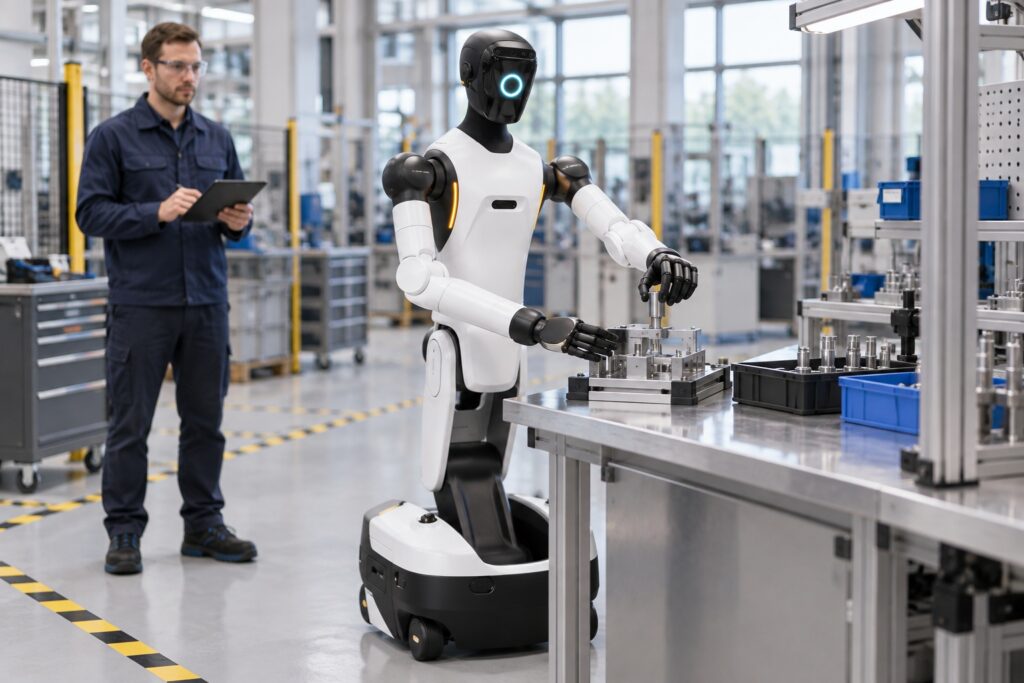
In manufacturing, a humanoid or mobile manipulator suits tasks that change, span several workstations or take place in an environment designed for people. Think of light assembly, loading machines in small batches and handling between stations. For one fixed task with a short cycle time, a cobot or robot cell is usually the better investment.
Three applications under the microscope
Assembly
Light assembly steps, such as placing or clicking parts into place, can be suitable. The Genie G2 has two force-controlled arms, which helps with fitting and placing. You need to test accuracy and speed with your own parts.
Machine tending
Loading CNC machines, presses or test set-ups is a well-known robot task. With one machine and large batches a cobot is often more efficient. A mobile manipulator becomes interesting when it serves several machines, or when batches are small and changing.
Handling
Moving products between stations, swapping bins or handing over parts. What counts most here is the flexibility to move between workstations.
Humanoid, mobile manipulator or cobot?
| Situation | Advice |
|---|---|
| One fixed workstation, large batches, short cycle time | Cobot or robot cell |
| Several machines, small and changing batches | Mobile manipulator (Genie G2) |
| Workstation for people that you do not want to rebuild | Humanoid or mobile manipulator |
| Heavy parts | Industrial robot or G2 Max, depending on the load |
| Fine finger movements | Testing with OmniHand, see robot hands |
You can read a detailed comparison in humanoid or industrial robot arm and humanoid vs cobot. On hands and grippers: robot hand vs gripper.
What to look out for
- Variation: the more variants, the more important it is that the robot can learn new tasks, for example through demonstrations in Genie Studio.
- Safety: ISO 10218-1 and -2:2025 puts the emphasis on the collaborative application, not just on the robot.
- CE and modifications: anyone who substantially modifies a machine legally becomes its manufacturer. That also applies if you integrate a robot into an existing line.
- Machinery Regulation: from 20 January 2027 new requirements apply, including for cybersecurity and self-learning behaviour.
How Humanoid-direct helps
As part of robot integrator WiredWorkers, we know cobots and robot cells as well as humanoids. That allows us to choose independently for each task. We help with a opportunity scan, a proof of concept using your parts and the implementatie.
Frequently asked questions
Can a humanoid replace a cobot?
Not as a one-to-one replacement. Each has its own strengths. For fixed tasks a cobot is often faster and cheaper to run.
How accurate is a mobile manipulator?
That depends on the task, the part and the set-up. We do not give general figures, but measure it in a proof of concept with your own parts.
Can the robot quickly do a new task after a product changeover?
That is the idea behind learning robots. How quickly depends on how much the task differs. Also read what happens when your product changes.