Humanoids and mobile manipulators in logistics and warehousing
Short answer
A humanoid or mobile manipulator fits in a warehouse for work that varies and takes place in spots set up for people, such as moving totes or supplying a workstation. For pallets, fixed flows and long transport routes, a forklift, AGV, AMR or robot cell is better. According to its manual, the AGIBOT G2 carries 5 kg per arm and only works between 0 and 45 degrees Celsius, so not in a freezer room. Start with one defined task and measure it on your own goods.
In brief
- A mobile manipulator is a robot with arms on a mobile base. It suits varying manual work between workstations, not pallets or fixed, fast flows.
- The AGIBOT G2 manual (release 30 July 2026) lists logistics handling as an application, but gives no performance figures for the warehouse.
- The G2 carries 5 kg per arm (10 kg with two arms, peak 15 kg), works indoors at 0 to 45 degrees Celsius and has a runtime of about 4 hours.
- For transport between points, AGVs and AMRs are often better, for pallets a forklift or palletizing robot, for a fixed spot a robot cell or cobot.
- Test one task with your own totes and products: share that succeeds first time, failures, pace and safety.
Where a mobile manipulator fits
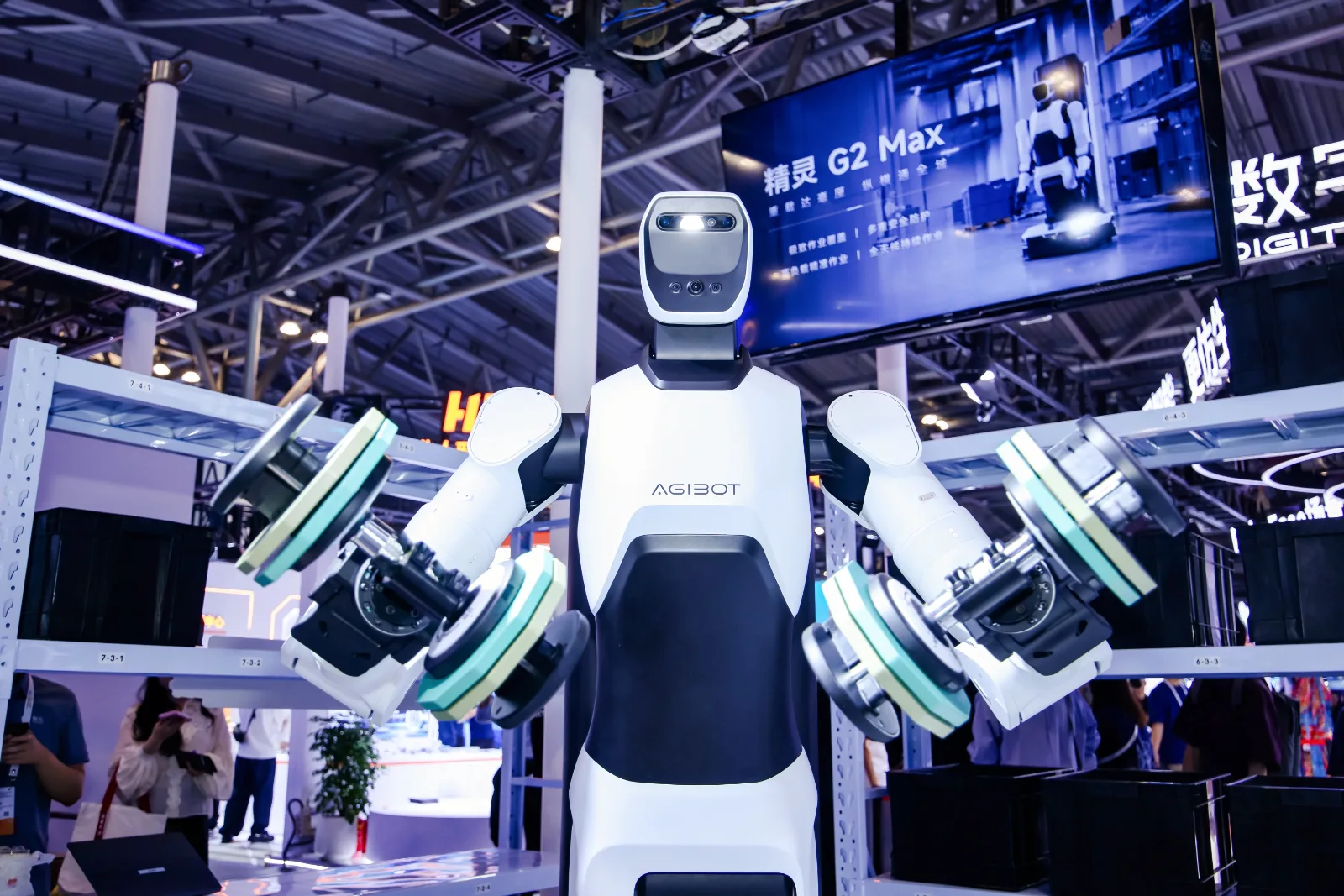
A mobile manipulator is a robot with arms on a mobile base. According to its manual (release 30 July 2026), the AGIBOT G2 has two arms with seven degrees of freedom each and a chassis with four steerable wheels. The manual lists logistics handling as an application, alongside precision assembly and inspection rounds, among others. It contains no example or performance figure from a warehouse.
Conceivable tasks are bringing totes from a rack to a workstation, handing products to a packing or assembly station and supplying a workstation. Those are examples of work that varies and is set up for people. AGIBOT does not document these tasks for the G2, so testing with your own goods is necessary. For loading and unloading machines, see loading and unloading production lines. For sorting and returns, read what AGIBOT itself reports in sorting in logistics and e-commerce.
When another robot type fits better
A humanoid or mobile manipulator is not the best choice for every task in a warehouse.
| Task | Better fit | Why |
|---|---|---|
| Moving or stacking pallets | Forklift, AGV or palletizing robot | The G2 carries 5 kg per arm |
| Fixed spot, fixed product, high cycle rate | Robot cell or cobot | Pace and repeatability count; see humanoid or cobot |
| Transport from A to B without handling | AMR or AGV | Built for routes and more load |
| Cold or freezer room | Equipment made for low temperatures | The G2 only works between 0 and 45 degrees Celsius |
| Varying handling between workstations | Mobile manipulator | One robot, several spots; test it |
What the G2 manual says
These limits apply to the G2 and say nothing about other versions. You can read about the variants in G2 Air, G2 and G2 Max.
- Load: 5 kg per arm, 10 kg with two arms, peak 15 kg.
- Dimensions and weight: height 1,225 to 1,795 mm, width 640 mm, length 760 mm, weight 185 kg.
- Speed and passage: maximum 1.5 m/s, minimum passage width 850 mm, obstacles up to 1.5 cm.
- Navigation: maps up to 10,000 m², accuracy of ±5 cm, with two LiDARs on the chassis.
- Environment: indoors, 0 to 45 degrees Celsius, humidity up to 90%.
- Battery: about 4 hours, two swappable batteries. The product page lists protection class IP42 for the entire machine.
What to look out for in a warehouse
- Floor and space: flat floor, no thresholds higher than 1.5 cm and aisles wider than 850 mm. Also read legs or wheels.
- Grip: boxes, bags and loose products each require a different gripper. The manual does not describe this per product type.
- Safety: the robot shares the space with people and sometimes with forklifts. Carry out a risk assessment.
- Systems: a link to your WMS is not in the manual. Ask what is possible.
- Operating time: allow for swapping or charging batteries and for who does that.
Realistic expectations
A mobile manipulator takes over a defined task today, not a complete role. In a trial with your own goods, measure the share that succeeds first time, the failures, the pace and the number of interventions by employees. A trial starts with an opportunity scan or a proof of concept.
Sources: AGIBOT G2 User Manual, AGIBOT G2 product page
Sources
- AGIBOT: G2 User Manual (release 30 July 2026) (checked on 2026-11-22)
- AGIBOT: G2 product page (undated, copyright 2023-2026) (checked on 2026-11-22)
Frequently asked questions
Can a mobile manipulator drive through the warehouse on its own?
According to the manual, the G2 has autonomous navigation to points on a map, with a map size of up to 10,000 m² and a minimum passage width of 850 mm. How well that works in your warehouse depends on floor, traffic and layout. You determine that in a trial.
Can the robot lift pallets?
No. The G2 carries 5 kg per arm, 10 kg with two arms and a peak of 15 kg. For pallets, a forklift, AGV or palletizing robot is more suitable.
Does it work in a cold room or freezer?
Not according to the manual. It specifies indoor use at 0 to 45 degrees Celsius and humidity of up to 90%. For cold spaces, look for equipment built for that.
Isn't an AMR or AGV better than a humanoid?
For transport from A to B, usually yes. An AMR or AGV is built for that and drives the same route far more often and with more load. A mobile manipulator only makes sense if the robot also has to pick up or place something along the way.
Can a mobile manipulator pick orders?
A defined task is possible, but the manual gives no picking performance. What AGIBOT itself reports about sorting is in the article on sorting in logistics.
How long does the robot run per battery?
According to the manual, about 4 hours, with two swappable batteries. For a day shift, plan for swapping or charging.