Loading and unloading production lines with a humanoid robot
Short answer
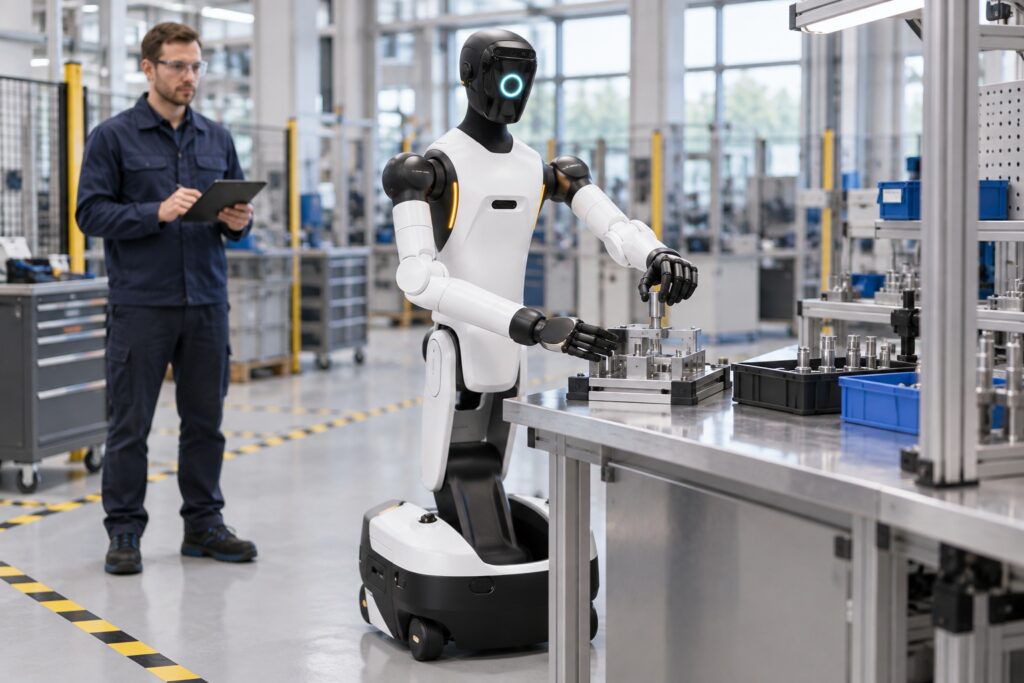
A robot with two arms on a mobile base can place products into and out of machines, trays and lines. How well that works in a real factory is only partly public so far. AGIBOT itself reports a six-day livestream at the Longcheer factory in June 2026 with 64,828 line tasks and 99.99% success. What a task is and when it succeeds, AGIBOT does not explain. Therefore measure cycle time and rejects on your own line before you take a manufacturer's figures as a starting point.
In brief
- Loading and unloading with a robot with two arms on a mobile base is an application that AGIBOT itself mentions, including at Longcheer in Nanchang.
- According to AGIBOT (article of 29 June 2026), several humanoid robots ran 64,828 line tasks live for six days with 99.99% success. A task and a success are not defined in the article.
- According to AGIBOT (article of 9 May 2026), robots at Longcheer process up to 5,700 units per day in 24/7 operation. The robot model, the period and what a unit is are not stated.
- According to the manual, the G2 battery life is approximately 4 hours with swappable batteries. Continuous operation therefore requires swapping or charging.
- Measure on your own line: cycle time, rejects, integration with the machine and safety. Compare with a fixed robot arm.
What this task is
Loading and unloading machines and lines is work at a fixed position with repeated movements: product from a tray into a machine, or from the machine to a next step. A robot with two arms on a mobile base can work there at existing machines, so you may not have to rebuild the line for a fixed robot cell. The AGIBOT G2 is such a robot. According to the manual, it has seven force-controlled degrees of freedom per arm, and the product page lists precision assembly as an application. Whether it can handle your product depends on weight, shape and tolerance. That requires a trial.
What AGIBOT reports from practice
Livestream at Longcheer. In an article of 29 June 2026, AGIBOT reports a six-day livestream from the factory of Longcheer Technology in Nanchang, China. Several humanoid robots worked in a quality inspection section of a tablet line and together carried out 64,828 line tasks over more than 64 hours, with a success rate of 99.99%. The robots took part in more than four production flows. The article also mentions a joint line output of 17,625. How this factory case is explained further is covered in the factory livestream.
What the article does not say: the robot model, what counts as one task, when a task has succeeded, what exactly the robots did and whether people helped or a robot was operated remotely. The success rate therefore says nothing about the rejects on your line.
Units per day. In an article of 9 May 2026 about seven applications, AGIBOT writes that robots at Longcheer process up to 5,700 units per day in continuous 24/7 operation when loading and unloading production lines. The article does not name the robot model, the period or what a unit is. It is a maximum, not an average.
What a robot needs to be able to do for this
The G2 manual of 30 July 2026 gives limits that matter for loading and unloading. They apply to the G2 and do not say that this was the robot at Longcheer.
- Rated load per arm 5 kg, with both arms together 10 kg and a peak of 15 kg.
- A maximum speed of 1.5 m/s, a minimum passage width of 850 mm and a height of 1,225 to 1,795 mm.
- A battery life of approximately 4 hours with swappable batteries, indoor use only at 0 to 45 degrees Celsius.
- The product page lists protection class IP42 for the entire machine.
Which variants of the robot exist is covered in G2, G2 Air or G2 Max.
What to look for
- Cycle time: compare the actual cycle time with a fixed robot arm. With a fixed position and fixed products, a robot arm may be faster and more suitable, see humanoid or industrial robot arm.
- Gripper or hand: choose the end effector to suit the product, see robot hand or gripper.
- Safety: carry out a risk assessment for the workstation.
- Integration: the robot has to know when the machine is done. Plan the integration with your controller.
- Continuous operation: allow for swapping or charging batteries and for who does that.
More on the factory environment: humanoid in manufacturing.
Sources: AGIBOT livestream at Longcheer, AGIBOT on the seven solutions, AGIBOT G2 User Manual, AGIBOT G2 product page
Sources
- AGIBOT: AGIBOT Concludes Six-Day Real Factory Livestream (29 June 2026) (checked on 2026-11-22)
- AGIBOT: How AGIBOT's Seven Solutions Are Reframing the Commercialization of Embodied AI (9 May 2026) (checked on 2026-11-22)
- AGIBOT: G2 User Manual (release 30 July 2026) (checked on 2026-11-22)
- AGIBOT: G2 product page (undated, copyright 2023-2026) (checked on 2026-11-22)
Frequently asked questions
How many units per day can a robot load and unload?
In an article of 9 May 2026, AGIBOT reports that robots at Longcheer process up to 5,700 units per day in 24/7 operation. The article names no robot model, no period and no definition of a unit. For your line it depends on product, distance and cycle time, so measure it yourself.
What does AGIBOT's livestream show?
According to AGIBOT (29 June 2026), several humanoid robots worked for six days in a quality inspection section of a tablet line at Longcheer in Nanchang, with 64,828 line tasks and 99.99% success. The article names no robot model and does not explain what a task is, what success is or whether people helped.
Is a humanoid better than a robot arm for machine loading?
Not always. With a fixed position and fixed products, a robot arm may be more suitable. A robot with two arms on a mobile base is more flexible if it has to serve several machines. Measure both on your line.
Can a robot work continuously?
AGIBOT mentions 24/7 operation at Longcheer. For the G2, the manual gives a battery life of approximately 4 hours with swappable batteries, so continuous operation requires swapping or charging. How it is arranged at Longcheer is not stated in the article.
Can I test this first?
That is the wisest route. A trial on your own line measures cycle time, rejects and the integration with your machine, with your products and your environment.