Robot dog for inspection and security: what can the D1 do?
Short answer
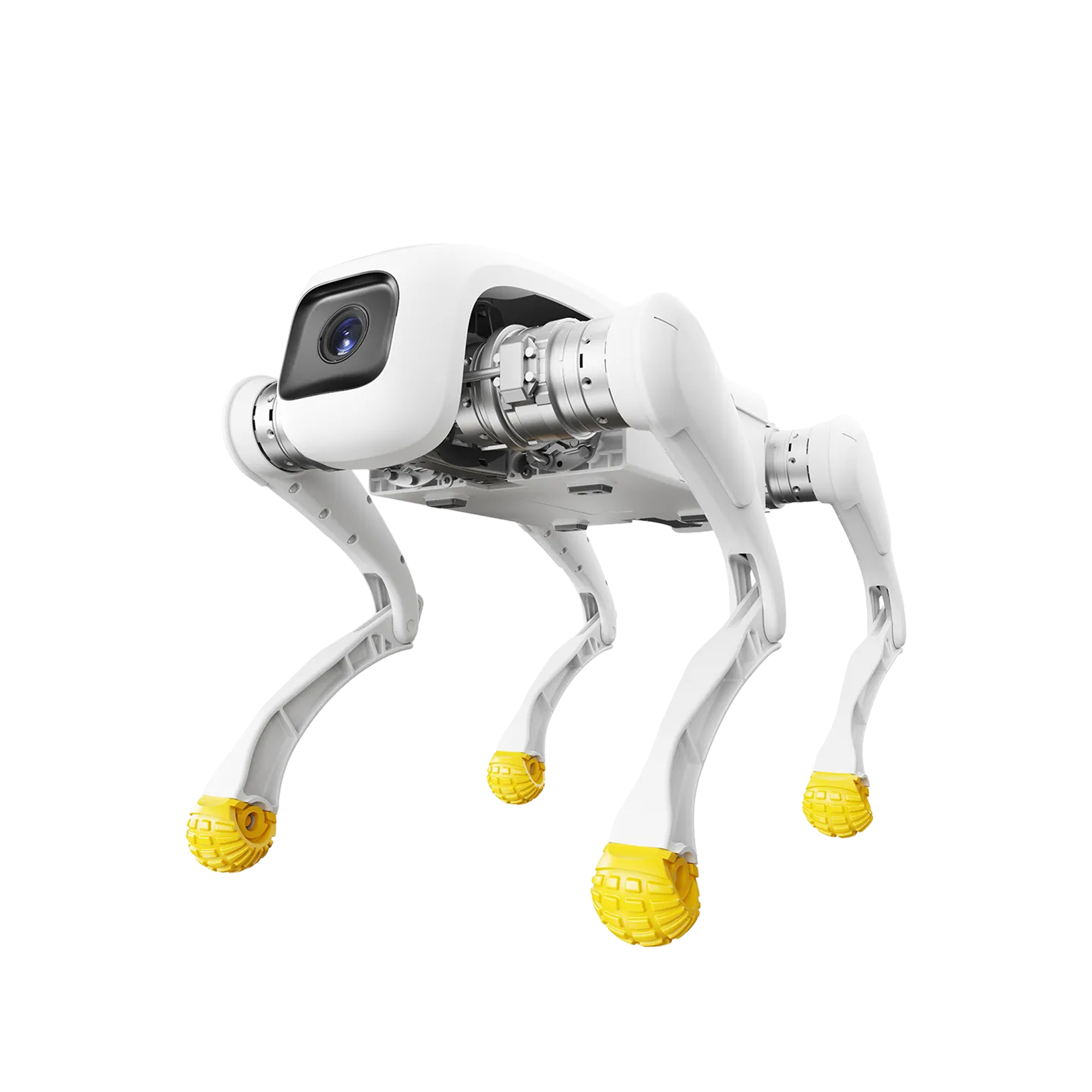
The AgiBot D1 is a robot dog. AgiBot names inspection and security among its applications. According to the product pages, the Pro or Edu takes stair steps up to 16 cm, the Pro, Edu and Ultra take slopes up to 40 degrees and the MaxPro walks continuous stairs up to 30 cm. Walking a route autonomously is not a standard function in the page text: AgiBot names optional modules such as LiDAR, depth camera and RTK, and following requires your own development according to the Ultra page. The values come from AgiBot's laboratory tests.
In brief
- AgiBot names inspection and security, among others, as an application for the D1. There are four versions: Pro and Edu, Ultra, Max and MaxPro.
- The versions differ in load, protection against dust and water, temperature range, and stair and slope capability. Part of the data is not in the page text.
- Walking a route autonomously requires extra modules and development. The documentation that was read describes no ready-made route planning.
- Images of identifiable people are personal data. If the robot can also observe employees, the works council may have a right of consent.
- Start with one route and fixed criteria, and have a person assess the alerts.
What AgiBot names the D1 for
On the D1 Ultra page, AgiBot names emergency assistance, security, inspection, education and entertainment as applications. The Max and MaxPro are built for heavier loads: the pages give 25 kg nominal and 50 kg sustained load. The data come from the product pages, read on 22 November 2026. Those pages show no date. For the Pro, Edu and Ultra, AgiBot writes that the values come from laboratory tests and may differ in practice.
The versions compared
| Version | Load | Speed | Stairs, slope | Protection | Other data |
|---|---|---|---|---|---|
| D1 Pro and Edu | 5 kg effective | 3.5 m/s | Steps up to 16 cm, slope 40 degrees | Not given | 15.5 kg, 0 to 40 degrees Celsius, 1 to 2 hours, 6 km ± 1 km |
| D1 Ultra | 5 kg effective | 3.7 m/s | Steps up to 16 cm, slope 40 degrees | IP54 | Open SDK, expansion ports, weight not given |
| D1 Max | 25 kg nominal | Not given | Obstacles 80 cm, slope 45 degrees | IP67 | Wheels and legs, at least 5 hours unloaded and 3.5 hours loaded, swappable batteries |
| D1 MaxPro | Up to 50 kg sustained | Not given | Continuous stairs up to 30 cm | IP67 | -20 to 55 degrees Celsius, 5.5 hours unloaded and at least 2 hours loaded, water up to 20 cm |
AgiBot uses different terms for load on each page: effective, nominal and sustained. Do not compare them without asking how they were measured. What the table lists as "not given" is missing from the page text. A full specification table may be on the page as an image; that was not read.
The Pro and Edu have the same data. The Edu also supports secondary development and has expansion ports (Ethernet, USB, power, SBUS and UART). A comparison of robots with wheels or legs is in robot with legs or wheels.
Walking patrols autonomously
An inspection patrol requires more than walking. The robot has to know where it is, follow a route, observe something and report it.
- What the pages name. For the Pro and Edu, AgiBot names optional modules for positioning, LiDAR, depth cameras and RTK. The Ultra page names 3D radar, depth camera, RTK, a 4G module, an image transmission module and a following module, and writes that intelligent following requires your own development.
- What the SDK offers. According to the README of the SDK for Edu and Ultra, you control the robot with commands such as stand up, move with a speed and direction, and jump, and you read out sensor data such as IMU and motor positions. The README of the MaxPro SDK names high-level and low-level control, image transmission, point cloud and odometry, with C++ as the supported language.
- What is missing. In the pages and SDK texts that were read, there is no ready-made route planning or inspection software. That does not mean it does not exist. Ask the supplier or integrator who delivers the routes, the recognition and the alerts.
What to look out for
- Environment. Dust, water, temperature and ground determine which version suits. See the table above and the protection rating and temperature range per version.
- Route. The more complex the route, the more important a test at your own location.
- Sensors. Decide in advance what you want to measure or see, for example images, sound or heat, and which module is needed for it.
- Follow-up. Who looks at the alerts and who intervenes?
- Privacy. According to the guidelines of the European data protection authorities (EDPB) on video devices, images in which people are recognizable by their appearance or other characteristics are personal data. Those guidelines concern camera surveillance in general and do not mention robots. They state that data with a short retention purpose can usually be deleted within a few days and that retention longer than 72 hours requires more justification. More is in camera images and privacy.
- Works council. The Works Councils Act requires the consent of the works council for a scheme on the processing of personal data of staff and for facilities aimed at or suitable for observing or monitoring staff presence, behavior or performance. Whether the robot dog falls under that depends on what it can observe. See the works council and robotization.
- Cybersecurity. A robot on your network calls for agreements on access and updates. See cybersecurity of robots.
Robot dog or fixed camera?
This is a trade-off of our own and not a research outcome. A fixed camera looks at one spot. A robot dog can walk past several spots, even if the route changes. The more different spots you want to check, the more worthwhile a robot can become. For one fixed spot, a fixed sensor is simpler. Sometimes a combination makes sense: fixed sensors for the overview and the robot for on-site checks.
Realistic expectations
A robot dog walks patrols, can collect images and sensor data and can report deviations if there is software for it. A person assesses and acts. Start with one fixed route and clear criteria: what should the robot find, how often and with what reliability? Test that in a proof of concept on your own route.
Sources: AgiBot D1 Pro/Edu, AgiBot D1 Ultra, AgiBot D1 Max, AgiBot D1 MaxPro, SDK D1 Edu and Ultra, SDK D1 MaxPro, EDPB Guidelines 3/2019, Works Councils Act
Sources
- AgiBot: D1 Pro/Edu product page (read 22-11-2026, page gives no date) (checked on 2026-11-22)
- AgiBot: D1 Ultra product page (read 22-11-2026, page gives no date) (checked on 2026-11-22)
- AgiBot: D1 Max product page (read 22-11-2026, page gives no date) (checked on 2026-11-22)
- AgiBot: D1 MaxPro product page (read 22-11-2026, page gives no date) (checked on 2026-11-22)
- GitHub: AgibotTech/agibot_D1_Edu-Ultra (SDK, README) (checked on 2026-11-22)
- GitHub: AgibotTech/Agibot_D1_MaxPro (SDK, README) (checked on 2026-11-22)
- EDPB: Guidelines 3/2019 on processing of personal data through video devices (final version, 2020) (checked on 2026-11-22)
- wetten.overheid.nl: Works Councils Act (Wet op de ondernemingsraden) (in force from 18-02-2023, consulted 22-11-2026) (checked on 2026-11-22)
Frequently asked questions
Can the D1 walk a route autonomously?
The page text that was read contains no standard route navigation. For the Pro, Edu and Ultra, AgiBot names optional modules such as LiDAR, depth camera and RTK, and writes on the Ultra page that following requires your own development. Ask whether a supplier or integrator delivers a complete patrol function.
Can the robot dog work outdoors in the rain?
According to AgiBot, the D1 Ultra has protection rating IP54, the D1 Max and MaxPro IP67. For the Pro and Edu, no rating is given in the page text. Ask AgiBot which conditions the rating covers in your situation and pay attention to the temperature range: the MaxPro works from -20 to 55 degrees Celsius, the Pro and Edu from 0 to 40.
Which D1 carries the most?
According to AgiBot, the MaxPro with a sustained load of up to 50 kg, then the Max with a nominal load of 25 kg. The Pro, Edu and Ultra give 5 kg effective load. AgiBot uses different terms for load on each page. Ask which measuring method is behind it.
What is the difference between the D1 Pro and the D1 Edu?
According to AgiBot, the Edu supports secondary development and has expansion ports (Ethernet, USB, power, SBUS and UART). The Pro does not have them.
Are camera images from a robot dog personal data?
According to the guidelines of the European data protection authorities (EDPB) on video devices, images in which people are recognizable by their appearance or other characteristics are personal data. The guidelines concern camera surveillance in general, not robots specifically. Delete images within a few days: according to the guidelines, retention longer than 72 hours requires more justification.
Does the works council have a right of consent?
Possibly. The Works Councils Act requires consent for a scheme on the processing of personal data of staff and for facilities aimed at or suitable for observing or monitoring staff presence, behavior or performance. Whether a robot falls under that depends on what it can observe.
Where can I find the D1 SDK?
AgiBot publishes SDK repositories on GitHub for the D1 Edu and Ultra and for the D1 Max and MaxPro. The documentation of the MaxPro SDK lists C++ as the supported development language.