From demo to pilot to production
Short answer
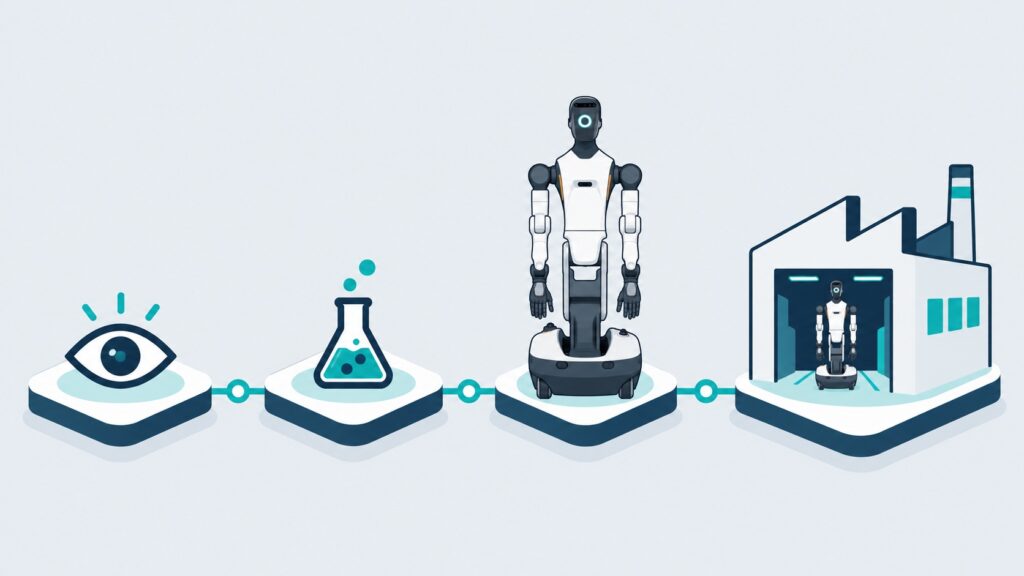
You bring a humanoid robot to production in four steps, and each step proves something different. A demonstration shows what the robot can do. A proof of concept tests one critical assumption. A practical pilot tests the task temporarily in your own environment. Implementation is the structural deployment, with handover and service. You start where your question lies and decide after each step whether to continue. Define upfront when a step has succeeded, because a no is then also a valid outcome.
In brief
- Four steps: demonstration, proof of concept, practical pilot and implementation. Each step answers a different question.
- A successful demo is not proof for production. That proof comes from a test on your own task.
- Choose a first task that is well-defined, repeatable and safe under supervision.
- Define success criteria upfront: success rate over a fixed number of attempts, cycle time, number of interventions and acceptance.
- AgiBot itself describes a loop of recording few demonstrations, training and trying it out on the robot.
- Yes, yes with conditions and no are all three usable outcomes.
The four steps side by side
| Step | What it shows | Setup | Your next decision |
|---|---|---|---|
| Demonstration | What the robot can do in a prepared session | Short, at the provider's site or yours | Is this interesting for our task? |
| Proof of concept | Whether one critical assumption holds, for example: does the robot pick up this object reliably? | Limited setup | Is the task technically feasible? |
| Practical pilot | Whether it works in your space, at your pace and with your people | Temporary, in a representative environment | Do we meet the success criteria? |
| Implementation | Structural deployment with handover, training and service | Project with delivery | Scale up or expand? |
You do not have to go through every step. If you already know the task is feasible, you can start with a practical pilot. If you are still unsure, start with an opportunity scan to sharpen the application. This step model is a way of working and not a standard. It is not derived from a source.
What the manufacturer itself describes
In its technical report on AgiBot World, AgiBot describes how data and model grow together. The team collects a small set of demonstrations, trains a policy (the model that decides what the robot does) and deploys that policy to assess whether the data are usable. The demonstrations are recorded with VR control or with full-body motion capture, and staff afterwards assess whether each recording meets the requirements. For a new task, AgiBot fine-tunes the model with high-quality, task-specific demonstrations.
For your project, that is a usable pattern: start small, test on the robot itself and only expand when the outcome is good enough. The report does not state a number of demonstrations per task for GO-1. How many demonstrations a task needs, you can read in how many demonstrations a robot needs.
On 13 April 2026, AgiBot announced the Genie Studio Agent, a platform for assembling robot applications with a visual editor and testing them in simulation first before they run on the real robot. For your pilot, nothing changes at the core: you assess the outcome on the real robot.
Which task do you choose for a first pilot?
Choose one task that is well-defined and repeatable, has visible value and can be done safely under supervision. A successful small pilot says more than a half-finished large one. The full criteria are in which task to have a humanoid do first. In short:
- Well-defined: clear start and end, few exceptions.
- Repeatable: the task occurs often enough to learn from.
- Safe in case of an error: a miss causes no damage or danger.
- Under supervision: someone nearby can intervene.
- Measurable: you can count how often it succeeds and how much time it takes.
If a task is mainly fast and fixed in one place, a cobot or robot cell often fits better than a humanoid.
Define success criteria upfront
Before a proof of concept or pilot, agree on when it counts as a success. Make the criteria measurable and suited to the phase:
- Success rate: how often the task succeeds over a fixed number of repetitions. Agree on the number of attempts upfront, because a percentage without a number says little.
- Cycle time: the time per cycle, compared with the current work.
- Interventions: how often an employee has to intervene or recover.
- Safety and acceptance: what the risk assessment of the setup yields and how employees experience the robot.
- Scaling up: what is needed to go from one task to more tasks or locations.
Be careful with figures from research. In the research on ACT, a method for learning from few demonstrations, six difficult tasks reached 80 to 90% success after about 10 minutes of demonstrations. That concerns a laboratory setup with tasks the researchers chose themselves and says nothing about your process. Use such figures as a prompt for a question, not as an expectation.
The outcome is yes, yes with conditions or no. All three are valuable: even a well-founded no saves you from a wrong investment.
Who do you involve?
A pilot succeeds best with a small, fixed team: a project manager, the task owner from operations, someone from engineering or IT, purchasing for the conditions and management for the decision. Who trains the robot and who adjusts it later is covered in who trains the robot.
From pilot to implementation
If you want to continue after a successful pilot, define who owns the trained tasks and the data, which documentation you receive, how service is arranged and who retests when something changes. The implementation checklist elaborates on this. You can request a proof of concept or practical pilot separately.
Sources: AgiBot World (arXiv), AgiBot World, HTML version, Genie Studio, Genie Studio Agent, ACT (arXiv). Checked on 22 November 2026.
Sources
- arXiv: AgiBot World Colosseo: A Large-scale Manipulation Platform for Scalable and Intelligent Embodied Systems (AgiBot World Contributors, March 2025, v5 October 2026) (checked on 2026-11-22)
- arXiv (HTML version v4): AgiBot World Colosseo, sections III-A, III-B and V-A (checked on 2026-11-22)
- AGIBOT: Genie Studio (product page) (checked on 2026-11-22)
- AGIBOT: Genie Studio Agent (announcement of 13 April 2026) (checked on 2026-11-22)
- arXiv: Learning Fine-Grained Bimanual Manipulation with Low-Cost Hardware (ACT, April 2023) (checked on 2026-11-22)
Frequently asked questions
Does a successful demo prove the robot is ready for production?
No. A demo shows what the technology can do in a prepared session. Whether it works in your environment, you test in a proof of concept or practical pilot. For its GO-1 model, AgiBot reports more than 60% success on complex tasks in its own evaluations. That is a research result and not a guarantee for your task.
What is the difference between a proof of concept and a practical pilot?
A proof of concept tests one critical assumption in a limited setup, for example whether the robot picks up a certain object reliably. A practical pilot tests the task temporarily in a representative environment, with your people and at your pace.
Do we have to buy the robot before we run a pilot?
That depends on the agreements per project. A demonstration or initial exploration usually does not require a purchase decision. Make clear upfront what a proof of concept or pilot includes and what remains if you stop.
Can we stop after a proof of concept?
Yes. A well-founded decision to stop is a valid outcome and prevents a wrong investment. Therefore define upfront at which outcome you stop.
How long does it take from demo to production?
That depends on the task. A well-defined task with clear success criteria is the fastest. No fixed number can be given. For recording data, AgiBot describes a loop of recording a small set of demonstrations, training a policy and trying it out on the robot. You repeat that loop until the outcome is good enough.
Can I test the robot in simulation before a pilot?
Partly. For Genie Studio, AgiBot reports calibrated simulation environments with less than 5% difference between GO-1 test results in simulation and on the real device. That is a manufacturer claim for those environments. Therefore always test your own task on the real robot as well.