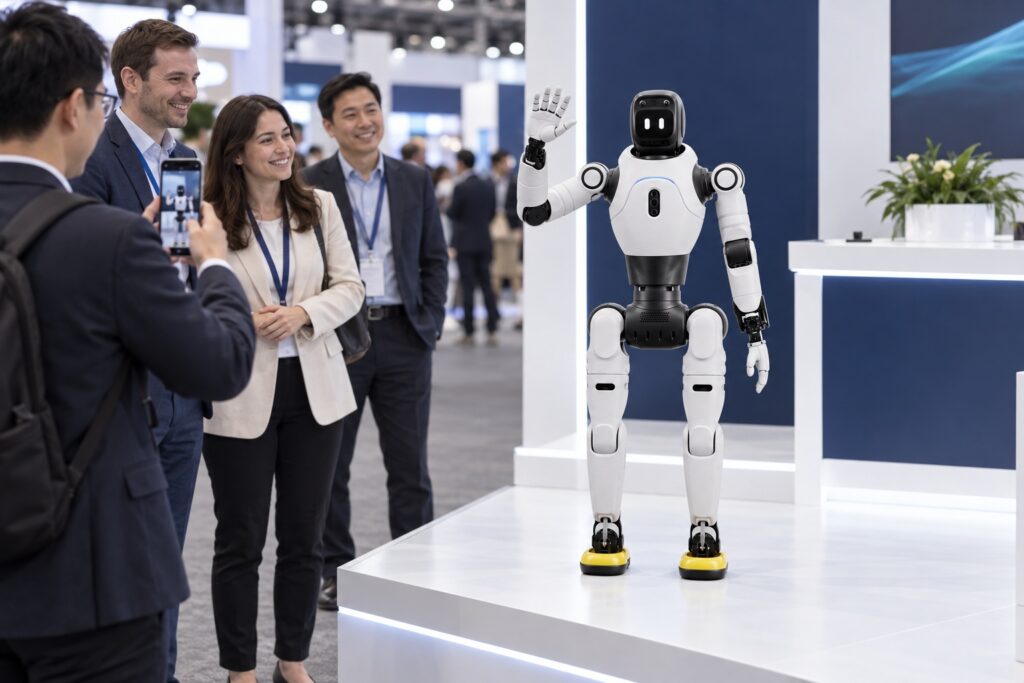
A humanoid robot at your trade show or event
Short answer
For a humanoid robot at a trade show or event, you decide in advance on three things: what the robot should do, which model suits that and who arranges transport, power, network and supervision. For the X2 Ultra, AGIBOT lists tours, reception and live events, and for the A3 commercial performances. Which safety zone and which network you need depends on the hall, the floor and the crowd. Agree on that in advance and test the setup on site.
In brief
- First determine the robot's purpose at the stand, then choose the model.
- For the X2 Ultra, AGIBOT lists tours, reception and live events, and for the A3 commercial performances.
- An industrial trade show calls for a different program than a reception desk. Show work then, instead of a host.
- Agree on a safe zone, power, network and supervision in advance and test on site.
- This checklist is general advice. Specifications per model come from the manufacturer.
Purpose first
Determine what the robot should do at your stand: welcome visitors, give a demonstration, support a talk or show work on the floor. That determines the model, the program and the space. A robot that attracts attention but has no purpose delivers little. Measure in advance what you want to achieve, for example the number of conversations.
Which model fits?
AGIBOT lists the following applications on its product pages. Those pages are undated, only the copyright (2023-2026) is shown.
| Model | What AGIBOT lists | Note |
|---|---|---|
| X2 Ultra | tours, reception and live events, about 1.31 m tall | compact; which languages are supported is not stated |
| A3 | commercial performances, including dancers, martial artists and art installations | performance, not a stand conversation |
| G2 | industrial tasks; AGIBOT calls it an industrial task robot in a post dated 28 June 2026 | shows work on the floor, not a host |
Specifications such as battery runtime and dimensions differ per version. Take them from the manufacturer's current documentation and not from this article. More applications are in humanoid in retail and hospitality.
The program
This is general advice and not a specification of a model.
- Guided introduction: a short explanation with live movement or interaction.
- Stand demos: repeatable segments at fixed times, so that you can plan swap moments.
- Presentation with a robot: a talk with a live example, with a fallback if something does not work.
- Interaction with visitors: within a bounded zone and under supervision.
Choose a bounded task that you can show reliably, see which task first.
What you arrange in advance
| Item | Agree in advance |
|---|---|
| Safety | a bounded zone, supervision and a risk assessment, see risk assessment |
| Network | your own network and a second connection, see Wi-Fi at a trade show |
| Logistics | transport, unloading location, build-up, tear-down and a flat floor |
| Power | a connection and a plan for swapping or charging batteries |
| Organization | contact with the stand builder and trade show organization, and a point of contact during build-up and opening hours |
| Program | times, repeatable segments and who operates the robot |
Who supplies this, arranges it or supervises, you agree with the party from whom you buy or rent the robot.
Sources: X2 Ultra product page, A3 product page, AGIBOT on the 15,000th robot (28 June 2026)
Sources
- AGIBOT: X2 Ultra product page (undated, copyright 2023-2026) (checked on 2026-11-22)
- AGIBOT: A3 product page (undated, copyright 2023-2026) (checked on 2026-11-22)
- AGIBOT: AGIBOT's 15,000th Robot Rolls Off the Production Line (28 June 2026) (checked on 2026-11-22)
Frequently asked questions
Which humanoid suits a trade show or event?
That depends on the purpose. For the X2 Ultra, AGIBOT lists tours, reception and live events, and for the A3 commercial performances. For an industrial trade show, a robot that shows work suits better than a host. Choose after the purpose and the space, not the other way around.
Can the robot walk freely among visitors?
That depends on space, crowd, floor and the risk assessment. Agree in advance on a bounded zone and supervision. The article on risk assessment explains how to approach that.
Which network does the robot need?
A trade show hall is often congested for Wi-Fi. For a demo, set up your own network and keep a second connection ready. What AgiBot documentation says about connections is in the article on Wi-Fi at a trade show.
What do I need to arrange in advance with the trade show organization?
Stand location and unloading location, a flat floor, power, space for a safe zone and a point of contact during build-up and opening hours. Also ask about the hall's rules for equipment.
How long can the robot run in a row at a stand?
That is stated per model in the manufacturer's documentation and differs. Ask for the current battery runtime and the swapping option and plan swap moments into the program.
Is a robot at a stand worth it?
That depends on your goal. A robot requires preparation, supervision and a bounded program. Without a clear goal, such as conversations or leads, it mainly brings attention.